

The Offshore Support Journal Conference returned to London in February 2026, bringing together shipowners, charterers, class societies, and technology providers to discuss the current state of the OSV market and its outlook.
Opsealog was present at the event, with Arnaud Dianoux and Damien Bertin attending multiple panels and discussions, both as speakers and as sponsors of the Renewables Award of the Year. The following key takeaways reflect both on-site discussions and broader industry perspectives shared during the conference.
Market outlook: high day rates meet wait-and-see caution
Discussions at OSJ London reflected a period of cautious stability. Day rates remain high, and demand is expected to stay strong throughout 2026. There was broad agreement that activity levels in 2027 remain harder to anticipate, reinforcing a wait-and-see approach across the sector.
Total offshore EPC (engineering, procurement & construction) spending dropped from $52 billion in 2024 to $46 billion in 2025, with approximately 50% concentrated in the Middle East, particularly Saudi Arabia. This geographic shift reflects broader priorities around energy security and independence, creating opportunities for operators positioned in these regions.
Investment decisions reflect this mindset. Shipowners continue to prioritize asset utilization and operational discipline rather than expansion.
Fleet aging and life extension as the default strategy
One of the most discussed operational realities at OSJ London was the age of the global OSV fleet. A large share of vessels is now over 15 years old, making life extension a standard approach rather than a temporary solution.
Newbuild costs remain high, with DP2 class vessels exceeding USD 30 million. Even with a potential shipyard window opening over the next 12 to 24 months, there is limited appetite for new orders. Regulatory uncertainty and capital discipline continue to favor extending the life of existing assets.
This strategy places increasing pressure on maintenance planning, fuel performance, and day-to-day operational consistency. Older vessels demand tighter control of how they are operated, not only to manage costs, but also to maintain reliability and availability.
Decarbonization & Renewables: regulation should not be the trigger for action
Regulations and requirements around decarbonization remain unclear, both following the IMO’s October 2025 decisions and regarding EU ETS applicability for OSVs. As a result, decarbonization is not currently treated as an urgent operational priority across much of the sector. Offshore renewable activity continues to face challenges, including limited short-to-mid-term project delivery and financing constraints.
Yet the conversation at OSJ London highlighted a different perspective: waiting for regulatory pressure is not the only path. Companies can take proactive steps to influence outcomes, implement operational solutions, and demonstrate leadership in efficiency, fuel management, and emissions monitoring. Being an active participant allows fleets to apply best practices, contribute to industry standards, and position themselves as front-runners in emerging initiatives.
Digital transformation and AI: “Efficiency is the only currency that matters.”
Digitalization and artificial intelligence featured prominently at OSJ London, with multiple presentations highlighting practical use cases already deployed across OSV fleets.
The key message, emphasized by Arnaud Dianoux, was the importance of building solid foundations before scaling advanced analytics. When applied to well-structured data and real workflows, digital tools and AI support fuel monitoring, maintenance planning, compliance reporting, and performance analysis. Their role is to enhance operational decision-making, not replace judgment or ownership.
Arnaud Dianoux’s presentation at OSJ London is available here:
Industry leaders attending OSJ London rated the OSV sector’s digital maturity at 2 out of 5, highlighting both progress made and remaining opportunities to extract value from operational data.
Efficiency emerged as the central operational principle.
Captain Mohamed Al Ali, Senior Vice President, Offshore Logistics at ADNOC L&S, stated that “efficiency is the only currency that matters”, capturing the broader industry mindset”, while Arnaud Dianoux added how this principle translates into practice: intelligent OSVs leverage data to “advise crews and analytics on shore to achieve efficiency gains.” Together, these perspectives link the sector’s strategic focus with concrete operational implementation.
Read more in Riviera Maritime Media’s article, “How OSV owners can use AI to enhance operations, reduce costs”.
Long-Term Energy Outlook Remains Supportive
Looking beyond near-term uncertainties, several long-term trends were expressed. Consensus was reached that oil prices need to remain in the $55–60 per barrel range to ensure sustainable offshore development, and most importantly, oil and gas production is expected to increase over the next decade.
Some projections indicated that an additional 70 million barrels per day will be needed by 2035 to satisfy growing global energy demand. This outlook provides fundamental support for the OSV market, reinforcing that oil and gas will remain critical components of the global energy mix for decades to come.
Offshore Renewables Award
And the winner of the Offshore Renewables Award goes to Huisman.
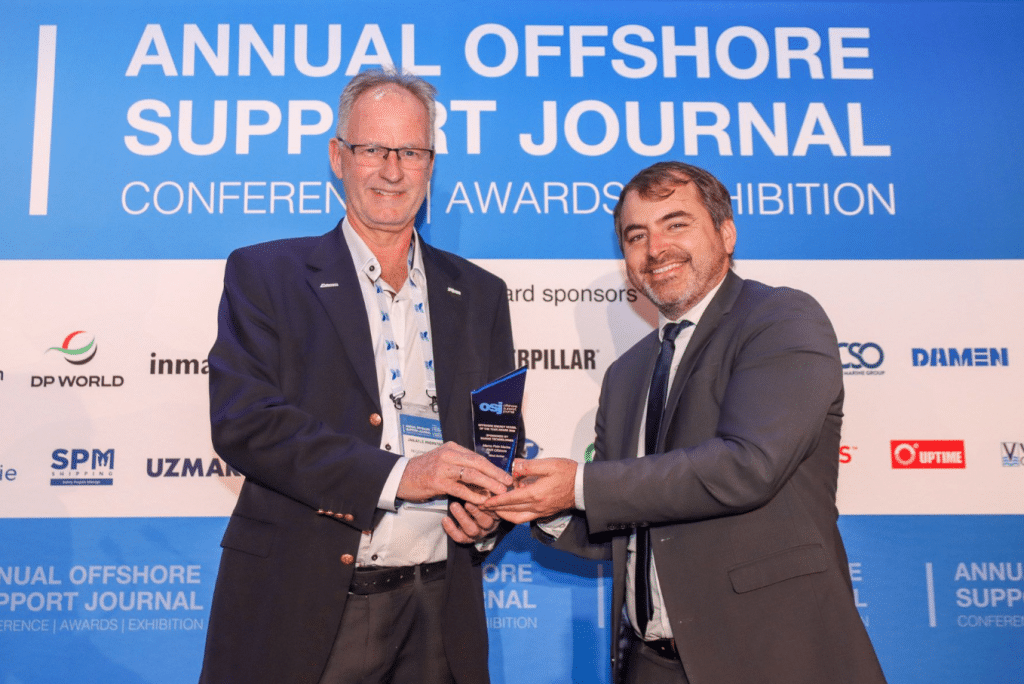
Opsealog participated as a sponsor of the award dedicated to offshore renewables initiatives. Huisman was recognized for their modular Cable-Lay System, a project that enables rapid vessel conversion for cable installation and supports export, inter-array, and repair operations. Fully integrated with tensioners, winches, and motion compensation, the system enhances safety, uptime, and operational efficiency, reduces logistics, and extends weather windows.
In short, what OSV fleets should remember:
✓ High utilization and high day rates continue to define operational priorities
✓ Life extension, digitalization, and maintenance discipline remain central topics
✓ Measure and improve vessel usage behaviors, including safety, fuel efficiency, and cargo optimization
✓ Regulatory uncertainty should not prevent proactive action on emissions and decarbonization
✓ AI supports efficiency only when applied to structured data and clear processes
Curious to learn more about Opsealog? Contact us!